


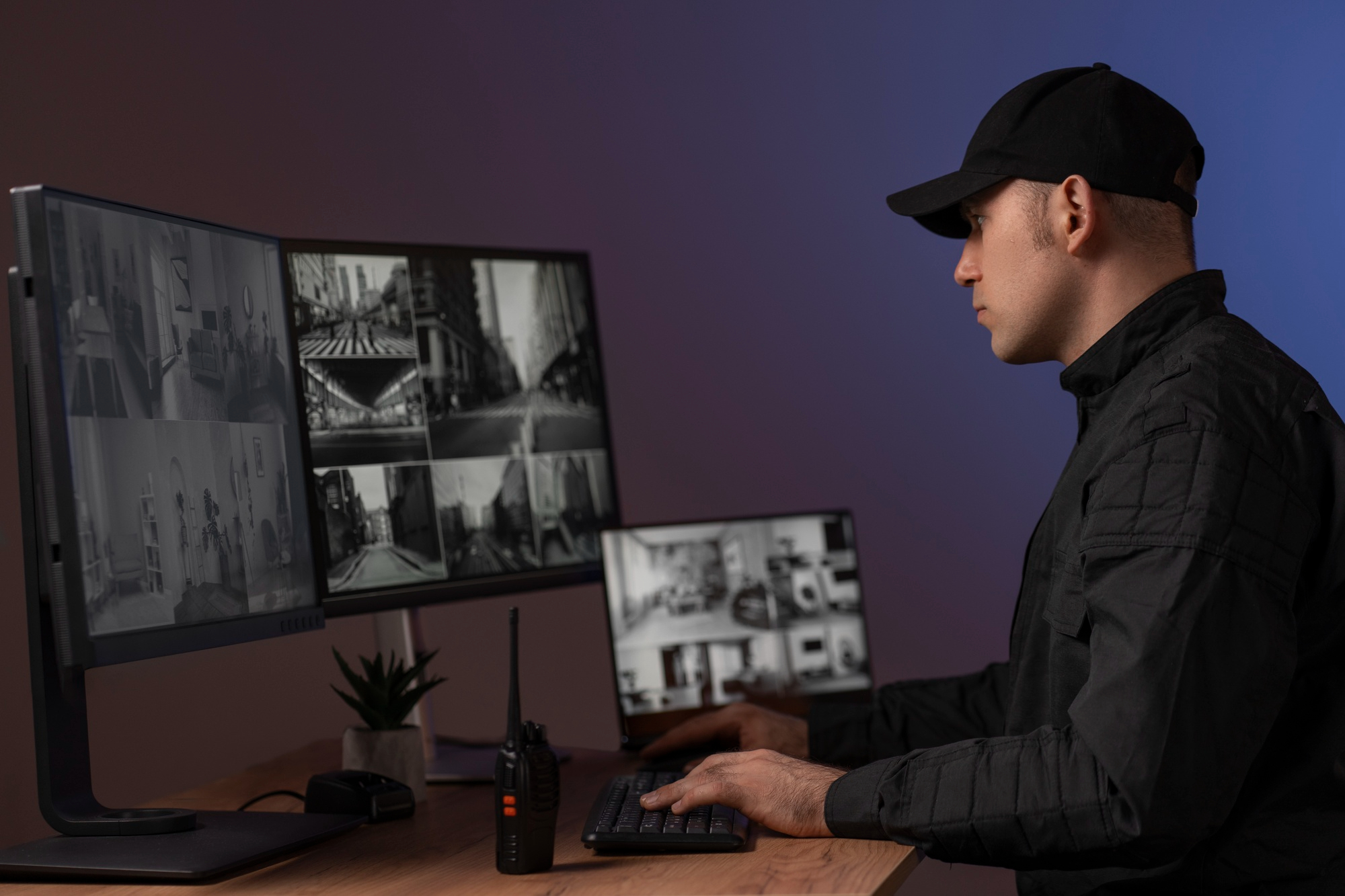

Are you monitoring your properties or overall security and watching quietly?
Of course, they record everything for sure, but when something goes wrong, you review footage later, but sometimes it’s of no use.
What if your security video monitoring system could predict before you notice something is wrong?
AI remote video monitoring system (RVM) made it possible.
You can get a real-time, intelligent, and highly capable security system that can alert you to threats before they happen.
In this blog post, we are going to discuss how AI is impacting remote video monitoring and the evolving impact of AI on RVM.
Remote video monitoring is an effective security strategy to protect various assets and ensure proper security. Security personnel can monitor from different locations at a time with a centralized control room. The RVM systems are capable of capturing clear footage without missing a detail.
RVM systems that are powered by AI technology have transformed physical security with proactive intelligence. With the usage of advanced analytics and machine learning technologies, AI systems are accurately predicting vulnerabilities and potential threats.
This shift has enabled the security to address the issues before they escalate. This ensures better protection and safety with a proactive approach. The ability of AI to quickly analyze large data sets helps in the identification of trends and anomalies that we might miss during traditional surveillance.
AI surveillance systems are far more capable compared to physical surveillance systems. Here are the benefits that help you understand its capabilities.
When you look into the long-term benefits and higher value potential, AI is affordable. There may be upfront costs, but the long-term benefits outweigh everything. AI remote monitoring systems can reduce the overall dependency on physical surveillance and other labor operational costs. It helps in the prevention of theft, vandalism, and operational disruptions.
AI has the super ability to analyze large volumes of data with utmost speed and accuracy that humans can’t match. Compared to the traditional systems that depend mainly on manual monitoring of screens, this may lead to missed cues and distractions. But AI works 24/7 with real-time detailing and flags suspicious behavior instantly. It cuts down the false alarms and helps security teams to stay focused on what matters.
According to the global AI surveillance market, it is forecasted that the AI surveillance market will reach over $21 billion and become the most trusted in the surveillance industry.
Time is always critical when dealing with security threats, but AI will not miss a point. They are designed to identify and quickly respond to the risks in real time. Be it spotting an unknown bag or object in crowded places or the detection of breaches at access points, it immediately alerts the security to take action. Thus, it helps in reducing the incident response time.
In a 2023 report from a reputable organization, it is revealed that the AI-powered surveillance systems reduced their incident response times by 60%, making them sit in a safer and more secure environment.
Many organizations or individuals may think that AI hurts privacy wherever it is integrated. But it is not true. It improves the overall privacy as it shields the sensitive data from human exposure. AI can blur out the faces and license plates or personal identities unless it identifies a real threat. It maintains safety and individual privacy, too.
According to IBM’s 2023 report, AI-driven encryption helped them reduce data breaches by 30% globally.
AI remote monitoring systems analyze the patterns in real time and help in comparing the historical data. It helps in forecasting the risks before they escalate. Deloitte has noted that an AI surveillance system helps them reduce the unexpected downtime by 40%
Many industries are exposed to high-risk conditions; the AI surveillance systems ensure better safety. They can monitor the dangerous zones and detect unsafe behaviors. It helps in alerting the staff and preventing accidents. AI-powered monitoring systems are highly valuable in industries like mining, construction, and oil and gas.
The National Safety Council reveals that workplaces that are powered by AI have reported a 30% decrease in workplace accidents
Edge AI is generally referred to as AI-powered processing that is on-site, and it is directly connected to the camera or other devices like a network video recorder. It doesn’t depend on sending data to the cloud, as the analysis will happen locally.
Cloud AI in surveillance mainly depends on the remote servers for processing video footage from the cameras. It offers large-scale data storage and centralized monitoring with deep learning capabilities. It perfectly fits into complex and distributed setups.
| Feature | Edge AI | Cloud AI |
| Latency | Real-time data processing enables instant threat detection and action. | Cloud data transmission leads to high latency. Can expect a delay during critical events |
| Dependency on the Internet | Can work offline with limited connectivity. Ideal for remote or bandwidth-restricted areas | Need high-speed internet for live streaming and processing. |
| Bandwidth | Sends alerts or summaries to central servers and uses minimal bandwidth. | Usage of bandwidth is very high. Raw video footage should be uploaded continuously for analysis. |
| Scalability | Limited hardware capabilities of edge devices | Scalable and can add more devices. It manages centrally without any hardware upgrades. |
| Privacy and Security | Strong control over local data. Sensitive footage stays unless it is flagged. | May involve a greater risk of exposure. Data gets transmitted and stored in the cloud based on the third-party security involvement. |
| User-friendliness and security | May involve high upfront costs and lower long-term storage costs due to the advanced edge hardware. | The initial cost is low, but it may incur high ongoing costs because of cloud storage and fees connected to bandwidth. |
| Maintenance | Manual updating and local configuration are needed for devices | Easy to manage updates remotely across all |
| Usage | It can be used in remote construction sites, defense, and privacy-sensitive locations. | Airports, multi-site retail chains, smart cities, and places needing centralized analytics |
Top 5 misconceptions about AI in video monitoring
1. AI Surveillance Systems replace Human Security Jobs completely: AI supports and enhances the overall human monitoring by decreasing error and fatigue. Human judgment is still crucial in complex situations and final decision-making.
2. AI surveillance is about watching and recording everything. No, most AI systems are programmed to detect specific patterns; they don’t monitor everything unless triggered.
3. Violates privacy: Misleading, AI enhances privacy by covering confidential information. It minimizes unnecessary human viewing unless there is a threat.
4. Detects all threats from day one: Not really; AI systems improve over time through learning and training with data. The initial steps refine and sometimes lead to false positives or miss rare anomalies.
5. Too expensive: the costs have already dropped significantly compared to the last 3 years. Small businesses can deploy at an affordable price, tailored to their needs.
Businesses are increasingly trusting the AI-powered surveillance rather than checking it as a simple security tool. More than 62% of enterprises reportedly integrated AI into their security infrastructure and improved operational efficiency and risk assessment. According to a PwC report, more than 70% of business leaders noticed AI surveillance systems playing a key role in smarter decision-making. So, it is clear that the perception of businesses towards AI surveillance systems is changing positively and will increase rapidly.
FAQ’s
1. What is AI Remote Video Monitoring (AI-RVM)?
AI Remote Video Monitoring (AI-RVM) is an intelligent surveillance system that uses artificial intelligence to analyze video feeds in real time, detect threats, and provide instant alerts—reducing the need for constant human oversight.
2. Can AI surveillance systems work without an internet connection?
Yes, Edge AI systems can function locally without relying on the internet. These are ideal for remote areas where connectivity is limited and real-time response is critical.
3. What’s the difference between Edge AI and Cloud AI in surveillance?
Edge AI processes data locally at the camera or device level for faster response and better privacy. Cloud AI sends data to remote servers for analysis and is ideal for large-scale, centralized monitoring.
4. What industries benefit the most from AI surveillance?
Industries like construction, oil and gas, mining, retail, logistics, and smart cities benefit greatly due to their high-risk environments and the need for real-time, scalable security solutions.
5. Can AI detect unusual or suspicious behavior?
Yes, AI uses pattern recognition and behavioral analytics to identify anomalies—such as loitering, perimeter breaches, or unattended objects—and alerts security teams immediately.